In my previous post, I discussed data-driven ways to align your content strategy with your audience’s challenges, and ensure you’re delivering the right content to demonstrate your expertise and credibility. However, while it’s important to understand where your audience stands, you should also periodically assess the health of your own content ecosystem.
In this regard, you should be asking the following questions: Are you providing a clear point of view and meaningful expertise on the right mix of topics to address your audience’s needs? Are you balancing content formats effectively across the customer journey? Is your content readily accessible? What parts of your existing content remain relevant and evergreen?
There are several ways to answer these questions using hard data. Visual analyses, including content heat-mapping and advanced statistical approaches can uncover useful insights into your content ecosystem that simple audits of your content library and campaign processes may miss. For example, the heat-map shown below is one way we can pull out more nuanced insights into how well your content strategy is working. Using this method, we can map topics that are salient to your audience across the customer journey and visualize where you’re addressing those topics and in what volume.
Visual analyses, including content heat-mapping and advanced statistical approaches can uncover useful insights into your content ecosystem that simple audits of your content library and campaign processes may miss.
The heat-map in figure 1, compiled from the oncology-focused content library for a life sciences organization, shows how this works in practice. This particular example reveals a significant degree of clustering. Large concentrations of content appear in awareness- and evaluation-stages, while comparatively little content supports the middle stages of the customer journey, or in several key decision-making topics. The content library mapped here addresses the extremes of the customer journey effectively, but underserves the crucial middle of the funnel.
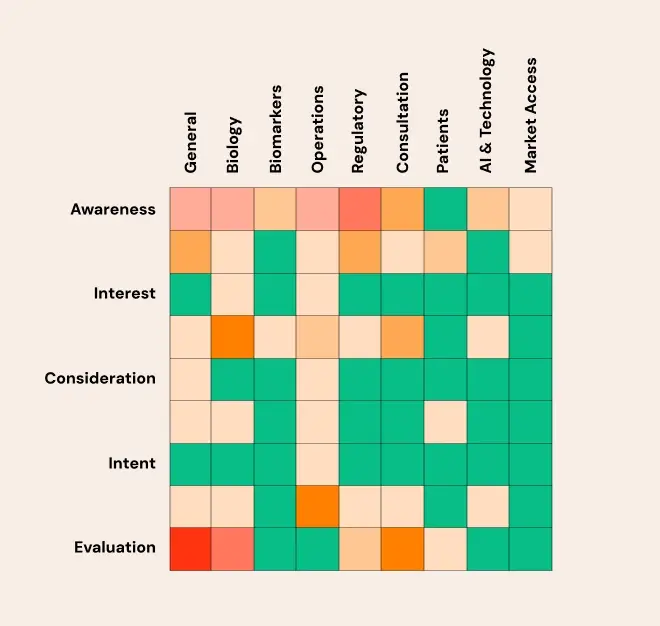
Those gaps in critical decision-making topics, including biomarker science, AI and technology, and market access consultation, can leave the audience empty-handed when they’re ready to engage. Expanding coverage in these areas would help the target audience better understand the depth of this organization’s expertise and could positively influence purchasing decisions. These are actionable insights that a heat-mapping analysis yields, which can inform future campaigns for this life sciences group.
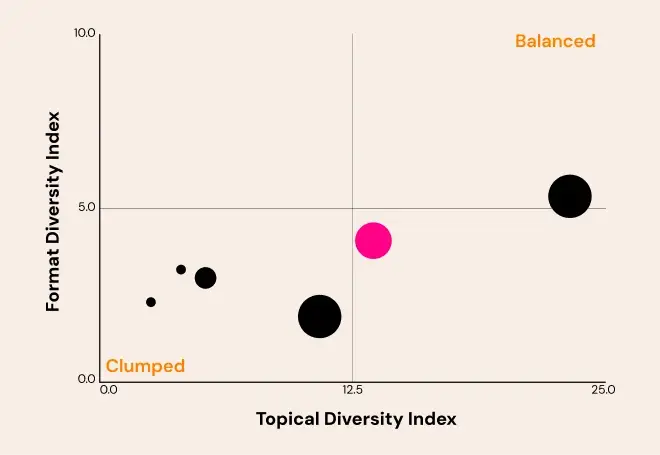
While heat-mapping highlights where content volume is concentrated and where imbalances exist across topics, formats and the customer journey, information gain analysis (IGA), a statistical approach in our strategy development kit, goes further and characterizes content ecosystems (figure 2). It evaluates the diversity of topics and formats within multiple content libraries — such as those of a client partner and its competitors — and indexes them against each other to assess content strategy balance.
IGA can be used to analyze content libraries, schedules of content campaigns, or even external datasets such as media share-of-voice audits. At a more strategic level, it can indicate how likely your content is to (1) speak to your audience’s challenges and interests, and (2) be found by them wherever they are in their customer journey. Ideally, your content library will map to the upper right-hand “balanced” corner.
In the IGA framework (figure 2), the horizontal axis reflects topical diversity, while the vertical axis reflects diversity across content formats and channels. Organizations positioned closer to the upper right-hand corner demonstrate stronger balance across both dimensions, while those clustered lower on the chart tend to concentrate content within narrower themes or channels.
When content strategy is balanced, it means your content spans a broad range of relevant topics and is delivered through a variety of formats that align with different stages of the customer journey. As a result, you demonstrate expertise consistently across the channels where potential clients, buyers and partners are most likely to engage.
In this context, IGA is designed to answer a simple question: How likely is your audience to gain relevant information from you wherever and whenever they encounter you? If your content strategy is “clumped” across very few topics or formats, the likelihood of reaching your audience and demonstrating your expertise drops dramatically.
This isn’t a surprising or new idea in content strategy. But it’s difficult to make practical use of it without good data to bring it to life and show you where your content strategy maps out in this spectrum.
IGA is designed to answer a simple question: How likely is your audience to gain relevant information from you wherever and whenever they encounter you?
Taking this ecosystem-level approach and measuring yourself against your competitors provides a better sense of where you need to apply your content efforts, and is especially useful when resources are limited. For example, the HDMZ partner illustrated in figure 2 mapped closer to the “balanced” region than most competitors. This indicates a stronger mix of topical coverage and format diversity, and allows the organization to focus competitive effort more precisely on a single competitor.
The data also suggested that improving format diversity would have greater impact than increasing topical diversity, pointing to a roughly 60%/40% allocation of effort in favor of format diversification. Insights like these provide a clear path forward.
Ultimately, content strategy is not a “set it and forget it” endeavor. By utilizing tools such as content heat-mapping and IGA, you can move beyond guesswork and build a robust, balanced ecosystem that truly resonates with your audience. Regularly assessing your content library ensures that you are not only filling the gaps in the customer journey, but also staying ahead of the competition. When you let data drive your strategy, you transform your content from a collection of assets into a powerful engine for credibility, engagement and growth.