Most biotech and life science companies play the waiting game. Wait for the next big financing announcement or regulatory milestone, or maybe for that one pivotal paper to publish so that they can finally share more about their science and technology.
In this standard model, communication is seen more as ceremonial, only used for moments of “importance,” assuming that the industry will simply pay attention when it counts. Sometimes it does. However, most times it does not.
Uncomfortable as it may be, a milestone is not a magic spell that automatically grabs attention, understanding or credibility. It does not, by itself, explain why your mechanism matters, why your disease area has been underserved, or why your team is the one to watch.
That’s because a milestone lands in a room. And that room is either warm or cold.
The best strategies build a narrative floor before milestones, establishing a baseline level of context that exists before the announcement happens. Without it, a single moment is asked to do far too much all at once: educate the market, persuade investors, interest reporters, validate the science, differentiate the company, excite prospective partners and establish executive credibility.
The myth of “the data will speak for itself”
Biotech loves the phrase “the data will speak for itself.” It’s noble, but not always true. The data definitely speaks. Yet, it needs translation and someone to explain all the intricate details and context that matter to a wide set of audiences.
For example, a unique and unconventional biomarker may be central to the clinical strategy, but overlooked and invisible to an investor. Unless someone has done the work of translating why these details matter, the outside world is likely to treat them as just another piece of clinical complexity.
If the industry already understands the disease burden, the company’s point of view and the credibility of the leadership team, then the milestone has a frame — people know how to interpret it and know why it might matter. If not, the company is forced to educate at the exact moment it needs momentum.
Showing progress and staying visible doesn't need its own press release; it needs consistent movement that compounds so that when a milestone hits, the market isn't asked to leap from zero to excitement with just a single announcement.
Silence is a dangerous position
Companies often go quiet between milestones because they think silence is prudent; however, it is not. Silence creates a vacuum, and — unfortunately or fortunately — vacuums get filled by competitors who are more visible and by analysts, journalists and investors who only partly understand your science.
It’s simple entropy: Attention decays, memory decays, curiosity decays.
A company can be genuinely progressing behind the scenes, while appearing frozen in time to outsiders. Showing progress and staying visible doesn’t need its own press release; it needs consistent movement that compounds so that when a milestone hits, the market isn’t asked to leap from zero to excitement with just a single announcement.
Two companies, same readout
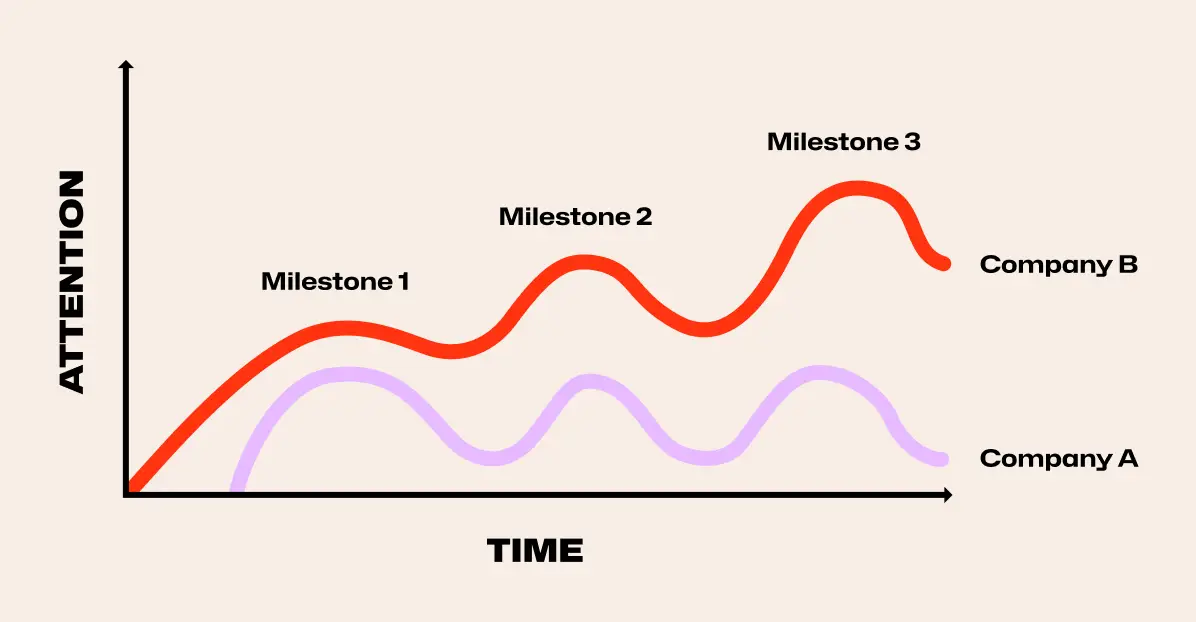
Let’s imagine two biotech companies approaching a major clinical readout. One gets a transactional headline and a shrug. The other gets thoughtful coverage and a sense of fitting into a larger arc. The difference is the narrative capital that existed before the data arrived.
Company A follows the milestone-only playbook: an announcement, a burst of coverage, then silence. Months later, new data arrives and the company has to explain everything at once, all while reporters are on deadline and investors are scanning for the next big thing. The room is cold.
Company B starts building its narrative floor months before the readout. It publishes thoughtful pieces on the disease area. Its CEO appears on panels. It builds relationships with journalists ahead of the data. When the readout arrives, reporters have context, investors have a frame and leadership is familiar. The milestone feels like the next chapter in a story already unfolding. The room is warm.
Building the room before you enter it
Staying relevant in the quieter moments doesn’t mean continually manufacturing news. Instead, companies have options:
- Owned channels: Stop saving all your thinking for the business deck
Owned channels, such as blogs, newsletters and podcasts, are one of the most underused tools in life science communications, as they can establish a company’s point of view and provide a space to think out loud about the disease area, the science and the unanswered questions the company is pursuing. Use owned content to build credibility, not to promote the asset in every paragraph, because authority isn’t claimed, it’s earned by making the market smarter. - Executive visibility: The leadership team also plays a part
A CEO or CSO who regularly shows up in the broader conversation — on panels, podcasts, webinars, social posts or in a well-placed op-ed — becomes a reference point for the field. Each appearance is a small, low-pressure chance to show how the company sees where things are headed and why its work belongs in that conversation, without the stakes of a formal announcement. - Journalist relationships: Do not start explaining the science on the deadline.
Too often, companies start educating reporters during the interview. That is how you get thin stories. The in-between period is when you brief reporters on background, explain the disease area and help them understand what real progress looks like. Of course, coverage is never guaranteed. However, understanding can be built long before the announcement, allowing the reporter who already knows the details to ask better questions.
The bottom line
The best data in the world still walks into a room it doesn’t control. You can spend months building context, or you can spend one press release hoping people fill in the blanks themselves.
Build the room, warm it up, then invite the guests.