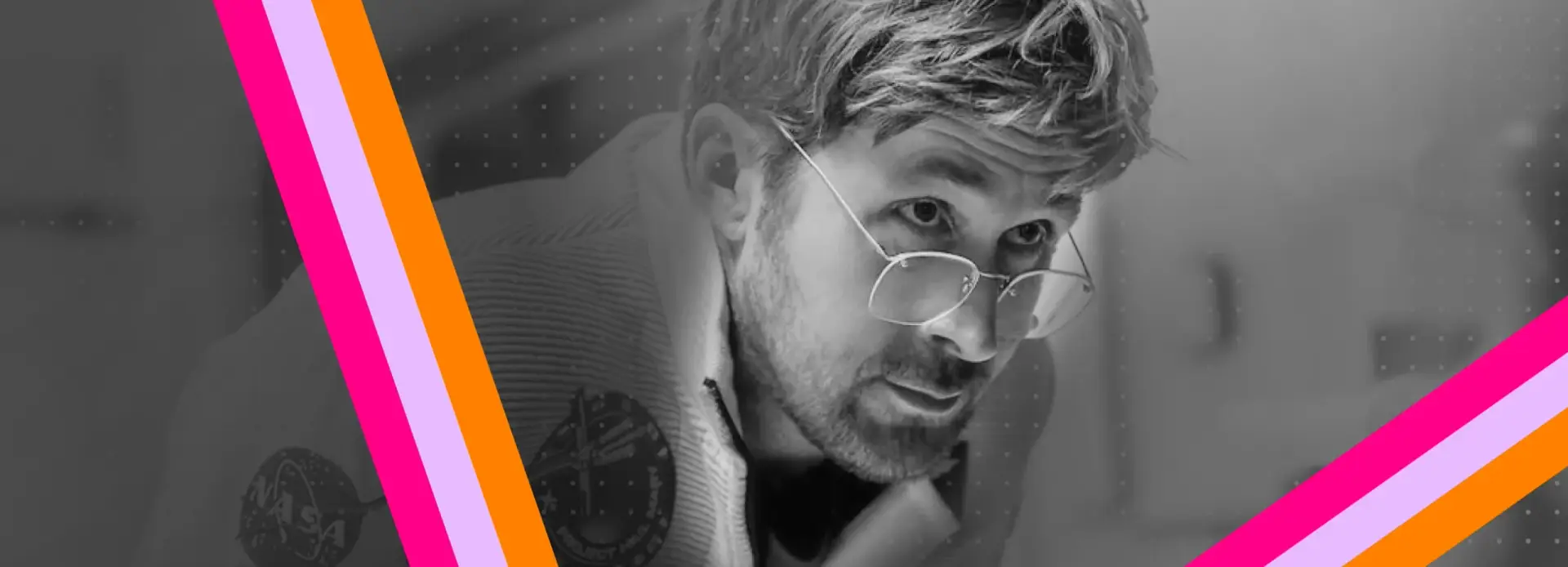
“Project Hail Mary” is a big-budget sci-fi movie starring Ryan Gosling as Ryland Grace, a scientist who has trouble communicating. Why does that sound familiar?
As much as “Project Hail Mary” is a movie about scientists saving the world, it’s also a movie about how scientists see themselves.
As much as “Project Hail Mary” is a movie about scientists saving the world, it’s also a movie about how scientists see themselves.
Grace is a very reluctant hero who clearly loves learning, discovery and teaching. While he lacks faith in himself, his faith in the scientific method never wavers.
Although “Project Hail Mary” leans into classic science fiction tropes, such as cryosleep and cute aliens, it grounds itself in a heartfelt depiction of a scientist unmoored — but still profoundly certain — of the scientific method. Grace isn’t a stereotypical sci-fi hero. He’s “not a pilot,” not a soldier, not an astronaut. He’s a bench scientist wearing charmingly nerdy periodic table T-shirts, with his pen behind his ear and glasses hanging off the side of his face. A slightly caricatured scientist, to be sure. However, this version — surrounded by spectrometers, microscopes, and even duct tape — felt familiar.
For years at HDMZ, across various campaigns and projects, I’ve had the opportunity to ask, “Who are scientists, really?” Or more importantly, “How do scientists see themselves?” The former is about discovery, the latter is about authenticity. “Project Hail Mary” may not have been entirely realistic, but it felt authentic. This authenticity often manifests in the unwavering devotion real-life scientists have to data and process. This is the kind of methodical, slightly chaotic brilliance Grace embodies, and it mirrors the passion we help communicate for our clients every day.
It’s Grace’s relationship with science that motivates his actions in the film. There are no scenes depicting his staring longingly at a picture of a family or a loved one back home. Yes, the relationship between Grace and Rocky (Grace’s new alien friend) gives the film its heart. However, it’s Grace’s scientific curiosity that largely keeps the plot moving.
By stripping Grace of his past, the story highlights a core truth: Curiosity is most powerful when it’s unburdened by “the way things have always been.” Real-world science frequently demands that we outgrow the status quo to make room for what’s next. In our industry, that might mean a biotech company abandoning a traditional diagnostic in favor of a new, life-saving standard of care, or developing an analytical tool that finally brings a complex disease pathway into focus.
It also rang true that, as a scientist, Grace’s biggest obstacle was one of communication, a struggle familiar to any scientist who has had to translate profound, complex discoveries into a format the rest of the world can grasp without losing the nuance of the data. In his book, “A Man on The Moon,” Andrew Chaikin writes about the struggles the Apollo astronauts faced when attempting to describe their experiences: “… astronauts are not communicators, and with rare exceptions, their words could not bridge the gap between the high-tech realm of spaceflight and everyday experience.” In the film, this communication gap is solved with a literal bridge between spaceships, and Grace’s conversation partner — an alien with whom he must learn to communicate — is quite possibly as dumb as a rock.
As science marketers, we deal with this communication gap daily. In the film, Grace was able to have a breakthrough in communicating with Rocky by taking advantage of a shared understanding of mathematics. In the real world, scientific innovations can be complex and technical. So, it’s important to know your audience first and speak their language (verbal, nonverbal, visual). Successful scientific communication is not only about what is said, but also how and where it’s presented. Much like the relationship between Grace and Rocky, it takes time and patience. (And no shouting, you’ll scare the little guy.)
The core message of “Project Hail Mary,” and the lesson we take into our daily work, is that science is a global, collaborative and inherently human endeavor, even when the collaborator is a multi-legged space rock.
Ryland Grace saves the world not through sheer heroism, but through the rigorous application of the scientific method and, eventually, a successful, patient attempt at communication. For us, the challenge remains the same: to bridge the gap between the bench and the boardroom, between the data and the decision-maker, and even, metaphorically, between the human and the alien. By identifying the audience’s mathematical equivalent — that shared, foundational knowledge — we can help scientists communicate their discoveries authentically and effectively. Like Grace, we put our faith in the method, and believe that with the right language and the right platform, the science that saves the day will finally be heard.